ByNatalie Dreier, Cox Media Group National Content Desk
Image 0 of 25
Solar eclipse FALMOUTH, ENGLAND - AUGUST 12: Image of the sun as it appears through the lens of a pair of solar eclipse glasses on August 12, 2026 in Falmouth, England. The partial solar eclipse is the most coverage during an eclipse viewed from the UK since 1999, with the moon covering 90-96% of the sun. Being situated in the far south west of the UK, people in Falmouth, Cornwall have the opportunity to watch the partial eclipse at a particularly high level of totality, with around 95 percent of the sun obscured. (Photo by Hugh Hastings/Getty Images) (Hugh Hastings/Getty Images)
Solar eclipse A CORUNA, SPAIN - AUGUST 12: People gather to observe the total solar eclipse at El Monte De San Pedro park on August 12, 2026 in A Coruna, Spain. It was the first time a total solar eclipse, when the sun is blocked by the moon's orbit, could be viewed from Spain since 1905. (Photo by Chip Somodevilla/Getty Images) (Chip Somodevilla/Getty Images)
Solar eclipse A CORUNA, SPAIN - AUGUST 12: A detailed view of the Solar eclipse before the Trofeo Teresa Herrera match between RC Deportivo A Coruna and Real Madrid at Riazor Stadium on August 12, 2026 in A Coruna, Spain. (Photo by Jose Manuel Alvarez Rey/Getty Images) (Jose Manuel Alvarez Rey/Getty Images)
Solar eclipse A CORUNA, SPAIN - AUGUST 12: People gather to observe the total solar eclipse at El Monte De San Pedro park on August 12, 2026 in A Coruna, Spain. It was the first time a total solar eclipse, when the sun is blocked by the moon's orbit, could be viewed from Spain since 1905. (Photo by Chip Somodevilla/Getty Images) (Chip Somodevilla/Getty Images)
Solar eclipse PALENCIA, SPAIN - AUGUST 12: The early stage of a total solar eclipse is seen on August 12, 2026 in Palencia, Spain. It was the first time a total solar eclipse, when the sun is blocked by the moon's orbit, could be viewed from Spain since 1905. (Photo by Leon Neal/Getty Images) (Leon Neal/Getty Images)
Solar eclipse A CORUNA, SPAIN - AUGUST 12: A man uses his mobile phone to observe the total solar eclipse at El Monte De San Pedro park on August 12, 2026 in A Coruna, Spain. It was the first time a total solar eclipse, when the sun is blocked by the moon's orbit, could be viewed from Spain since 1905. (Photo by Chip Somodevilla/Getty Images) (Chip Somodevilla/Getty Images)
Solar eclipse GUADALAJARA, SPAIN - AUGUST 12: People gather to watch the total solar eclipse on August 12, 2026 in Guadalajara, Spain. It was the first time a total solar eclipse, when the sun is blocked by the moon's orbit, could be viewed from Spain since 1905. (Photo by Pablo Blazquez Dominguez/Getty Images) (Pablo Blazquez Dominguez/Getty Images)
Solar eclipse PALENCIA, SPAIN - AUGUST 12: The early stage of a total solar eclipse is seen on August 12, 2026 in Palencia, Spain. It was the first time a total solar eclipse, when the sun is blocked by the moon's orbit, could be viewed from Spain since 1905. (Photo by Leon Neal/Getty Images) (Leon Neal/Getty Images)
Solar eclipse AMPOSTA, SPAIN - AUGUST 12: People gather to view the total solar eclipse on August 12, 2026 in the Riet Vell Nature Reserve in Amposta, Spain. It was the first time a total solar eclipse, when the sun is blocked by the moon's orbit, could be viewed from Spain since 1905. (Photo by James Breeden/Getty Images) (James Breeden/Getty Images)
Solar eclipse FALMOUTH, ENGLAND - AUGUST 12: Passengers on board the Princessa pleasure boat try out their solar eclipse glasses on August 12, 2026 in Falmouth, England. The partial solar eclipse is the most coverage during an eclipse viewed from the UK since 1999, with the moon covering 90-96% of the sun. Being situated in the far south west of the UK, people in Falmouth, Cornwall have the opportunity to watch the partial eclipse at a particularly high level of totality, with around 95 percent of the sun obscured. (Photo by Hugh Hastings/Getty Images) (Hugh Hastings/Getty Images)
Solar eclipse AMPOSTA, SPAIN - AUGUST 12: People gather to view the total solar eclipse on August 12, 2026 in the Riet Vell Nature Reserve in Amposta, Spain. It was the first time a total solar eclipse, when the sun is blocked by the moon's orbit, could be viewed from Spain since 1905. (Photo by James Breeden/Getty Images) (James Breeden/Getty Images)
Solar eclipse HODGDON, MAINE - AUGUST 15: (EDITOR'S NOTE: This Handout image was provided by a third-party organization and may not adhere to Getty Images' editorial policy.) In this NASA handout, the Sun during a partial solar eclipse, partially obscured by clouds, the International Space Station, with a crew of seven onboard, is seen in silhouette as it transits at roughly five miles per second on August 12, 2026, near Hodgdon, Maine. Onboard as part of Expedition 75 are: NASA astronauts Jessica Meir, Anil Menon, and Jack Hathaway; ESA (European Space Agency) astronaut Sophie Adenot; and Roscosmos cosmonauts Pyotr Dubrov, Andrey Fedyaev, and Anna Kikina. A total solar eclipse swept across parts of Greenland, Iceland, northern Russia, the Atlantic Ocean, Spain, and a small corner of Portugal. A Partial eclipse was visible in parts of the U.S., most of Canada, much of Europe, and northwest Africa. (Photo by Joel Kowsky/NASA via Getty Images) (NASA/Getty Images via NASA)
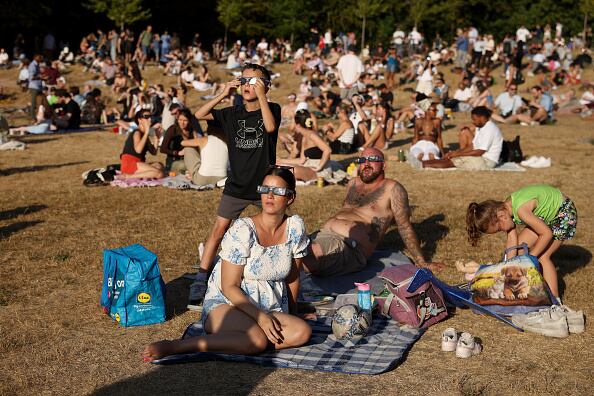
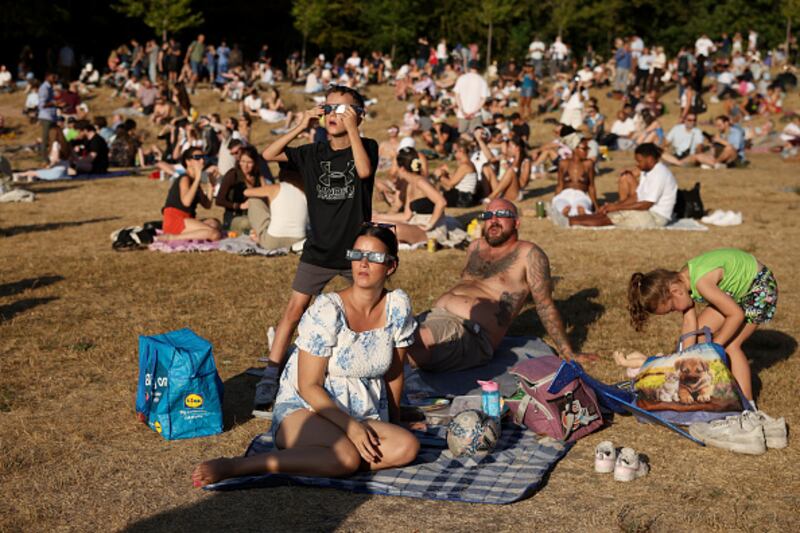
Solar eclipse LONDON, UNITED KINGDOM - AUGUST 12: People gather to watch the partial solar eclipse in Greenwich Park on August 12, 2026 in London, United Kingdom. The partial solar eclipse is the most coverage during an eclipse viewed from the UK since 1999, with the moon covering 90-96% of the sun. (Photo by Dan Kitwood/Getty Images) (Dan Kitwood/Getty Images)
Solar eclipse NOTTINGHAM, ENGLAND - AUGUST 12: People try to watch the Solar eclipse with special glasses before the pre-season friendly match between Nottingham Forest and Bayer 04 Leverkusen at City Ground on August 12, 2026 in Nottingham, England. (Photo by David Rogers/Getty Images) (David Rogers/Getty Images)
Solar eclipse FALMOUTH, ENGLAND - AUGUST 12: Members of the public gather on Gyllyngvase Beach to watch the partial solar eclipseon August 12, 2026 in Falmouth, England. The partial solar eclipse is the most coverage during an eclipse viewed from the UK since 1999, with the moon covering 90-96% of the sun. Being situated in the far south west of the UK, people in Falmouth, Cornwall have the opportunity to watch the partial eclipse at a particularly high level of totality, with around 95 percent of the sun obscured. (Photo by Hugh Hastings/Getty Images) (Hugh Hastings/Getty Images)
Solar eclipse LONDON, UNITED KINGDOM - AUGUST 12: People gather to watch the partial solar eclipse in Greenwich Park on August 12, 2026 in London, United Kingdom. The partial solar eclipse is the most coverage during an eclipse viewed from the UK since 1999, with the moon covering 90-96% of the sun. (Photo by Dan Kitwood/Getty Images) (Dan Kitwood/Getty Images)
Solar eclipse A CORUNA, SPAIN - AUGUST 12: People who arrived early rest while waiting for the total solar eclipse at El Monte De San Pedro park on August 12, 2026 in A Coruna, Spain. It will be first time a total solar eclipse, when the sun is blocked by the moon's orbit, will be viewed from Spain since 1905. (Photo by Chip Somodevilla/Getty Images) (Chip Somodevilla/Getty Images)
Solar eclipse LONDON, UNITED KINGDOM - AUGUST 12: People gather to view the partial solar eclipse in Greenwich Park on August 12, 2026 in London, United Kingdom. The partial solar eclipse is the most coverage during an eclipse viewed from the UK since 1999, with the moon covering 90-96% of the sun. (Photo by Dan Kitwood/Getty Images) (Dan Kitwood/Getty Images)
Solar eclipse PALENCIA, SPAIN - AUGUST 12: The early stage of a total solar eclipse is seen on August 12, 2026 in Palencia, Spain. It was the first time a total solar eclipse, when the sun is blocked by the moon's orbit, could be viewed from Spain since 1905. (Photo by Leon Neal/Getty Images) (Leon Neal/Getty Images)
Solar eclipse FALMOUTH, ENGLAND - AUGUST 12: A member of the public shows the four pairs of solar eclipse glasses they bought from a stall on Custom House Quay, on August 12, 2026 in Falmouth, England. The partial solar eclipse is the most coverage during an eclipse viewed from the UK since 1999, with the moon covering 90-96% of the sun. Being situated in the far south west of the UK, people in Falmouth, Cornwall have the opportunity to watch the partial eclipse at a particularly high level of totality, with around 95 percent of the sun obscured. (Photo by Hugh Hastings/Getty Images) (Hugh Hastings/Getty Images)
Solar eclipse LONDON, UNITED KINGDOM - AUGUST 12: People gather to watch the partial solar eclipse in Greenwich Park on August 12, 2026 in London, United Kingdom. The partial solar eclipse is the most coverage during an eclipse viewed from the UK since 1999, with the moon covering 90-96% of the sun. (Photo by Dan Kitwood/Getty Images) (Dan Kitwood/Getty Images)
ByNatalie Dreier, Cox Media Group National Content Desk
Some areas of the globe got an amazing show as parts of the world experienced a solar eclipse.
While parts of Greenland, Iceland and Spain had a total solar eclipse, parts of the U.S. were able to experience a partial eclipse.
The Associated Press said totality started at the North Pole and moved to Greenland, Iceland, Spain and part of Portugal, while in the U.S., the following cities got a little darker during the partial eclipse (all times local):
Anchorage, Alaska, 28% coverage beginning at 7:36 a.m., peaking at 8:21 a.m.
Bangor, Maine, 24% coverage beginning at 12:54 p.m., peaking at 1:53 p.m.
Detroit, 3% coverage beginning at 1:03 p.m., peaking at 1:36 p.m.
New York City, 9% coverage beginning at 1:07 p.m., peaking at 1:54 p.m.
Philadelphia, 7% coverage beginning at 1:11 p.m., peaking at 1:53 p.m.
Washington, D.C., 4% coverage beginning at 1:17 p.m., peaking at 1:53 p.m.
While the U.S. only had a partial eclipse this time around, the country is on tap to have a full eclipse, but not for a few more years. The next coast-to-coast total solar eclipse will happen in 2045, the AP reported.
You won’t have to wait that long to see a total eclipse, but you’ll have to travel to experience it. The next one will happen Aug. 2, 2027, but totality will be seen in North Africa and the Middle East, CNN reported.
If you were in an area that experienced the partial eclipse, you were reminded not to look directly at the sun. It could damage your eyes.
You should have used certified eclipse safety glasses. Sunglasses were not enough, according to NationalEclipse.com. If you didn’t have any, you can use a pinhole viewer. Using your cell phone camera, telescope, or other devices also required a solar filter, or you risked permanently damaging your eyes, making sure the filters were on the correct end of the viewer.
“Never attempt to view an eclipse through an optical device using eclipse glasses or any type of filter that attaches to the viewing side (as opposed to the Sun side) of the instrument; the focused light will destroy the filter and enter and damage your eyes,” the website said.
For more information on watching an eclipse safely, click here.
There is also one more safe option: watching the eclipse online.
Solar eclipse FALMOUTH, ENGLAND - AUGUST 12: Image of the sun as it appears through the lens of a pair of solar eclipse glasses on August 12, 2026 in Falmouth, England. The partial solar eclipse is the most coverage during an eclipse viewed from the UK since 1999, with the moon covering 90-96% of the sun. Being situated in the far south west of the UK, people in Falmouth, Cornwall have the opportunity to watch the partial eclipse at a particularly high level of totality, with around 95 percent of the sun obscured. (Photo by Hugh Hastings/Getty Images) (Hugh Hastings/Getty Images)
Solar eclipse A CORUNA, SPAIN - AUGUST 12: People gather to observe the total solar eclipse at El Monte De San Pedro park on August 12, 2026 in A Coruna, Spain. It was the first time a total solar eclipse, when the sun is blocked by the moon's orbit, could be viewed from Spain since 1905. (Photo by Chip Somodevilla/Getty Images) (Chip Somodevilla/Getty Images)
Solar eclipse A CORUNA, SPAIN - AUGUST 12: A detailed view of the Solar eclipse before the Trofeo Teresa Herrera match between RC Deportivo A Coruna and Real Madrid at Riazor Stadium on August 12, 2026 in A Coruna, Spain. (Photo by Jose Manuel Alvarez Rey/Getty Images) (Jose Manuel Alvarez Rey/Getty Images)
Solar eclipse A CORUNA, SPAIN - AUGUST 12: People gather to observe the total solar eclipse at El Monte De San Pedro park on August 12, 2026 in A Coruna, Spain. It was the first time a total solar eclipse, when the sun is blocked by the moon's orbit, could be viewed from Spain since 1905. (Photo by Chip Somodevilla/Getty Images) (Chip Somodevilla/Getty Images)
Solar eclipse PALENCIA, SPAIN - AUGUST 12: The early stage of a total solar eclipse is seen on August 12, 2026 in Palencia, Spain. It was the first time a total solar eclipse, when the sun is blocked by the moon's orbit, could be viewed from Spain since 1905. (Photo by Leon Neal/Getty Images) (Leon Neal/Getty Images)
Solar eclipse A CORUNA, SPAIN - AUGUST 12: A man uses his mobile phone to observe the total solar eclipse at El Monte De San Pedro park on August 12, 2026 in A Coruna, Spain. It was the first time a total solar eclipse, when the sun is blocked by the moon's orbit, could be viewed from Spain since 1905. (Photo by Chip Somodevilla/Getty Images) (Chip Somodevilla/Getty Images)
Solar eclipse GUADALAJARA, SPAIN - AUGUST 12: People gather to watch the total solar eclipse on August 12, 2026 in Guadalajara, Spain. It was the first time a total solar eclipse, when the sun is blocked by the moon's orbit, could be viewed from Spain since 1905. (Photo by Pablo Blazquez Dominguez/Getty Images) (Pablo Blazquez Dominguez/Getty Images)
Solar eclipse PALENCIA, SPAIN - AUGUST 12: The early stage of a total solar eclipse is seen on August 12, 2026 in Palencia, Spain. It was the first time a total solar eclipse, when the sun is blocked by the moon's orbit, could be viewed from Spain since 1905. (Photo by Leon Neal/Getty Images) (Leon Neal/Getty Images)
Solar eclipse AMPOSTA, SPAIN - AUGUST 12: People gather to view the total solar eclipse on August 12, 2026 in the Riet Vell Nature Reserve in Amposta, Spain. It was the first time a total solar eclipse, when the sun is blocked by the moon's orbit, could be viewed from Spain since 1905. (Photo by James Breeden/Getty Images) (James Breeden/Getty Images)
Solar eclipse FALMOUTH, ENGLAND - AUGUST 12: Passengers on board the Princessa pleasure boat try out their solar eclipse glasses on August 12, 2026 in Falmouth, England. The partial solar eclipse is the most coverage during an eclipse viewed from the UK since 1999, with the moon covering 90-96% of the sun. Being situated in the far south west of the UK, people in Falmouth, Cornwall have the opportunity to watch the partial eclipse at a particularly high level of totality, with around 95 percent of the sun obscured. (Photo by Hugh Hastings/Getty Images) (Hugh Hastings/Getty Images)
Solar eclipse AMPOSTA, SPAIN - AUGUST 12: People gather to view the total solar eclipse on August 12, 2026 in the Riet Vell Nature Reserve in Amposta, Spain. It was the first time a total solar eclipse, when the sun is blocked by the moon's orbit, could be viewed from Spain since 1905. (Photo by James Breeden/Getty Images) (James Breeden/Getty Images)
Solar eclipse HODGDON, MAINE - AUGUST 15: (EDITOR'S NOTE: This Handout image was provided by a third-party organization and may not adhere to Getty Images' editorial policy.) In this NASA handout, the Sun during a partial solar eclipse, partially obscured by clouds, the International Space Station, with a crew of seven onboard, is seen in silhouette as it transits at roughly five miles per second on August 12, 2026, near Hodgdon, Maine. Onboard as part of Expedition 75 are: NASA astronauts Jessica Meir, Anil Menon, and Jack Hathaway; ESA (European Space Agency) astronaut Sophie Adenot; and Roscosmos cosmonauts Pyotr Dubrov, Andrey Fedyaev, and Anna Kikina. A total solar eclipse swept across parts of Greenland, Iceland, northern Russia, the Atlantic Ocean, Spain, and a small corner of Portugal. A Partial eclipse was visible in parts of the U.S., most of Canada, much of Europe, and northwest Africa. (Photo by Joel Kowsky/NASA via Getty Images) (NASA/Getty Images via NASA)
Solar eclipse LONDON, UNITED KINGDOM - AUGUST 12: People gather to watch the partial solar eclipse in Greenwich Park on August 12, 2026 in London, United Kingdom. The partial solar eclipse is the most coverage during an eclipse viewed from the UK since 1999, with the moon covering 90-96% of the sun. (Photo by Dan Kitwood/Getty Images) (Dan Kitwood/Getty Images)
Solar eclipse NOTTINGHAM, ENGLAND - AUGUST 12: People try to watch the Solar eclipse with special glasses before the pre-season friendly match between Nottingham Forest and Bayer 04 Leverkusen at City Ground on August 12, 2026 in Nottingham, England. (Photo by David Rogers/Getty Images) (David Rogers/Getty Images)
Solar eclipse FALMOUTH, ENGLAND - AUGUST 12: Members of the public gather on Gyllyngvase Beach to watch the partial solar eclipseon August 12, 2026 in Falmouth, England. The partial solar eclipse is the most coverage during an eclipse viewed from the UK since 1999, with the moon covering 90-96% of the sun. Being situated in the far south west of the UK, people in Falmouth, Cornwall have the opportunity to watch the partial eclipse at a particularly high level of totality, with around 95 percent of the sun obscured. (Photo by Hugh Hastings/Getty Images) (Hugh Hastings/Getty Images)
Solar eclipse LONDON, UNITED KINGDOM - AUGUST 12: People gather to watch the partial solar eclipse in Greenwich Park on August 12, 2026 in London, United Kingdom. The partial solar eclipse is the most coverage during an eclipse viewed from the UK since 1999, with the moon covering 90-96% of the sun. (Photo by Dan Kitwood/Getty Images) (Dan Kitwood/Getty Images)
Solar eclipse A CORUNA, SPAIN - AUGUST 12: People who arrived early rest while waiting for the total solar eclipse at El Monte De San Pedro park on August 12, 2026 in A Coruna, Spain. It will be first time a total solar eclipse, when the sun is blocked by the moon's orbit, will be viewed from Spain since 1905. (Photo by Chip Somodevilla/Getty Images) (Chip Somodevilla/Getty Images)
Solar eclipse LONDON, UNITED KINGDOM - AUGUST 12: People gather to view the partial solar eclipse in Greenwich Park on August 12, 2026 in London, United Kingdom. The partial solar eclipse is the most coverage during an eclipse viewed from the UK since 1999, with the moon covering 90-96% of the sun. (Photo by Dan Kitwood/Getty Images) (Dan Kitwood/Getty Images)
Solar eclipse PALENCIA, SPAIN - AUGUST 12: The early stage of a total solar eclipse is seen on August 12, 2026 in Palencia, Spain. It was the first time a total solar eclipse, when the sun is blocked by the moon's orbit, could be viewed from Spain since 1905. (Photo by Leon Neal/Getty Images) (Leon Neal/Getty Images)
Solar eclipse FALMOUTH, ENGLAND - AUGUST 12: A member of the public shows the four pairs of solar eclipse glasses they bought from a stall on Custom House Quay, on August 12, 2026 in Falmouth, England. The partial solar eclipse is the most coverage during an eclipse viewed from the UK since 1999, with the moon covering 90-96% of the sun. Being situated in the far south west of the UK, people in Falmouth, Cornwall have the opportunity to watch the partial eclipse at a particularly high level of totality, with around 95 percent of the sun obscured. (Photo by Hugh Hastings/Getty Images) (Hugh Hastings/Getty Images)
Solar eclipse LONDON, UNITED KINGDOM - AUGUST 12: People gather to watch the partial solar eclipse in Greenwich Park on August 12, 2026 in London, United Kingdom. The partial solar eclipse is the most coverage during an eclipse viewed from the UK since 1999, with the moon covering 90-96% of the sun. (Photo by Dan Kitwood/Getty Images) (Dan Kitwood/Getty Images)








/cloudfront-us-east-1.images.arcpublishing.com/cmg/LH3JSJEF3VBLRJLJQESEAG34AM.png)


