

Family researchers have spent decades taking a look at how far parents end up living from their adult children, yet very little research focuses on the relationship between siblings. Even though they are the ones typically splitting holiday hosting, dividing up a parent’s care as they age, and making calls when things go wrong, how far apart they choose to live is not often in focus.
The distance between siblings isn’t necessarily a side effect of family life. It’s shaped by the same forces that pull every American family either apart or close.
No government agency tracks siblings' distance directly, but PeopleWin has put together a comprehensive report by leveraging data from the journal Mathematical Population Studies, Census migration data, AARP, Pew Research Center and more to paint a clear picture of how far American siblings tend to live from one another and why.
The national picture: How far apart do siblings really live?
Data published in Mathematical Population Studies using the Panel Study of Income Dynamics’ Family Information Mapping System shows that sibling pairs who no longer share a household live 157.5 miles apart, on average. Interestingly, it’s closer than the average distance between parents and adult children, who live about 181.3 miles apart. It is farther than the distance that usually separates grandparents from grandchildren.
This is a national average. Zooming in, and combining the results with Census migration data, it’s clear that siblings don’t scatter as far on a case-by-case basis. Around 11.5% still share a household together, 13.2% live in the same census tract, and 34.5% live in the same county. When you add in the 23.8% who remain in the same state without sharing a county, it ends up being true that more than eight in 10 sibling pairs are still within a state line of each other.
The remaining slice of siblings who cross state and regional borders are the ones pumping the national average upwards.
While this picture is focused on America, it's still helpful to know if the trend follows on a global basis. Sweden is roughly the same size as California and data from the Swedish Register shows that about 35% of older adults have a sibling within six miles and there is a median distance of only 14 miles to the nearest sibling across the country.
This data helps underscore how much the vast geography and varied labor market of America plays a role in the distance between siblings.
Regional variation: Why Southern and Midwestern families stay closer
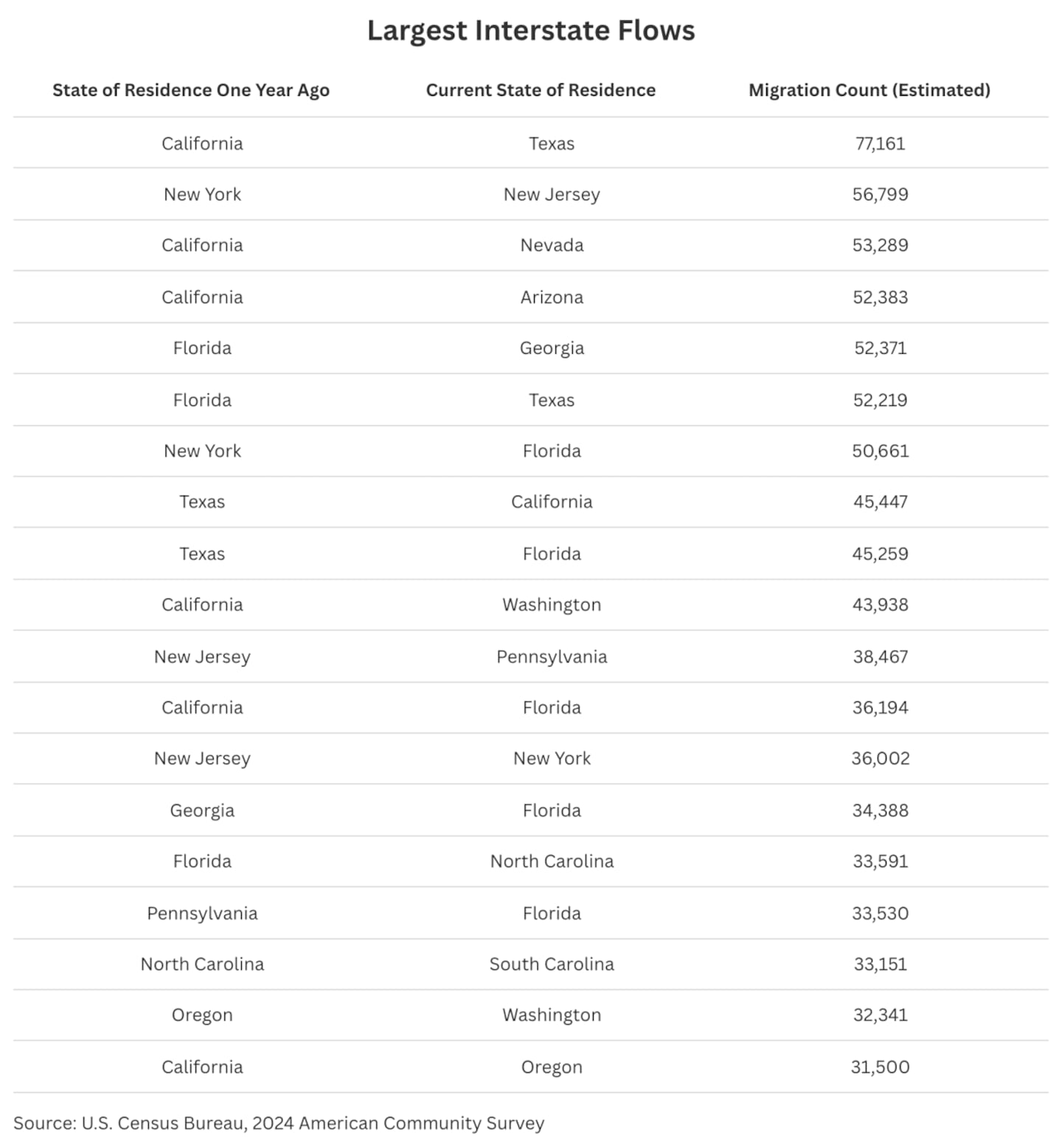
Some regions in the United States boast closer sibling networks than others, and Census migration data on the country’s largest interstate flows helps offer clarity:
PeopleWin
The biggest inflow of the country is from California to Texas. There was an estimated 77,161 influx in a single year, and tens of thousands going into Nevada, Arizona, Washington, Florida, and Oregon.
Moves like these are a cross-border choice driven by the economy or an opportunity that no amount of family connection can easily address. Given the size of the state, any move out of California is a significant distance.
Compare this with the flows that dominate the East Coast and the South. New York’s largest outbound was to New Jersey and was 56,799 people. While it’s still a city-to-city move, these residents are just hopping over the river. New Jersey’s own flow runs to Pennsylvania then back to New York. Florida and Georgia trade tens of thousands of residents back and forth. The same is true for North Carolina and South Carolina.
These are cross-border moves, but the proximity of the states and their smaller size makes it appear that these regions have closer family networks.
West Coast migration tends to be a longer haul, and people cross multiple state lines. In Southern and Midwest communities, families may hop just one state over. Siblings in these regions are closer both in geography and in emotional connection.
The inflection points: What pulls siblings apart
The distance gap between siblings can rarely be traced to one singular reason. Research indicates there are three main drivers that occur throughout a person’s life, on average, which are typically to blame:
- College attendance: Once one sibling leaves for a university outside of their local area, many people simply stay around their school after graduation for work opportunities, love, or just because they love the area.
- First job post-college: Pew Research found that 44% of those interviewed cited their first job or business opportunities as their reason for moving, followed by cost of living at 29%, increasing to 34% for those earning under $30,000 a year.
- Getting married or finding a partner: Younger siblings who find a partner are significantly less likely to live in the same household as their sibling, and they often live farther away when they don't.
Not everyone takes the paths in their lives that lead them away from family. Of the people who never left their hometown cities, 74% of them cite family ties as the reason they stayed. College graduates are also far more likely to have moved multiple times compared to those with a high school diploma, so education plays an important role too.
The consequences: Elder care, estates, and emotional closeness
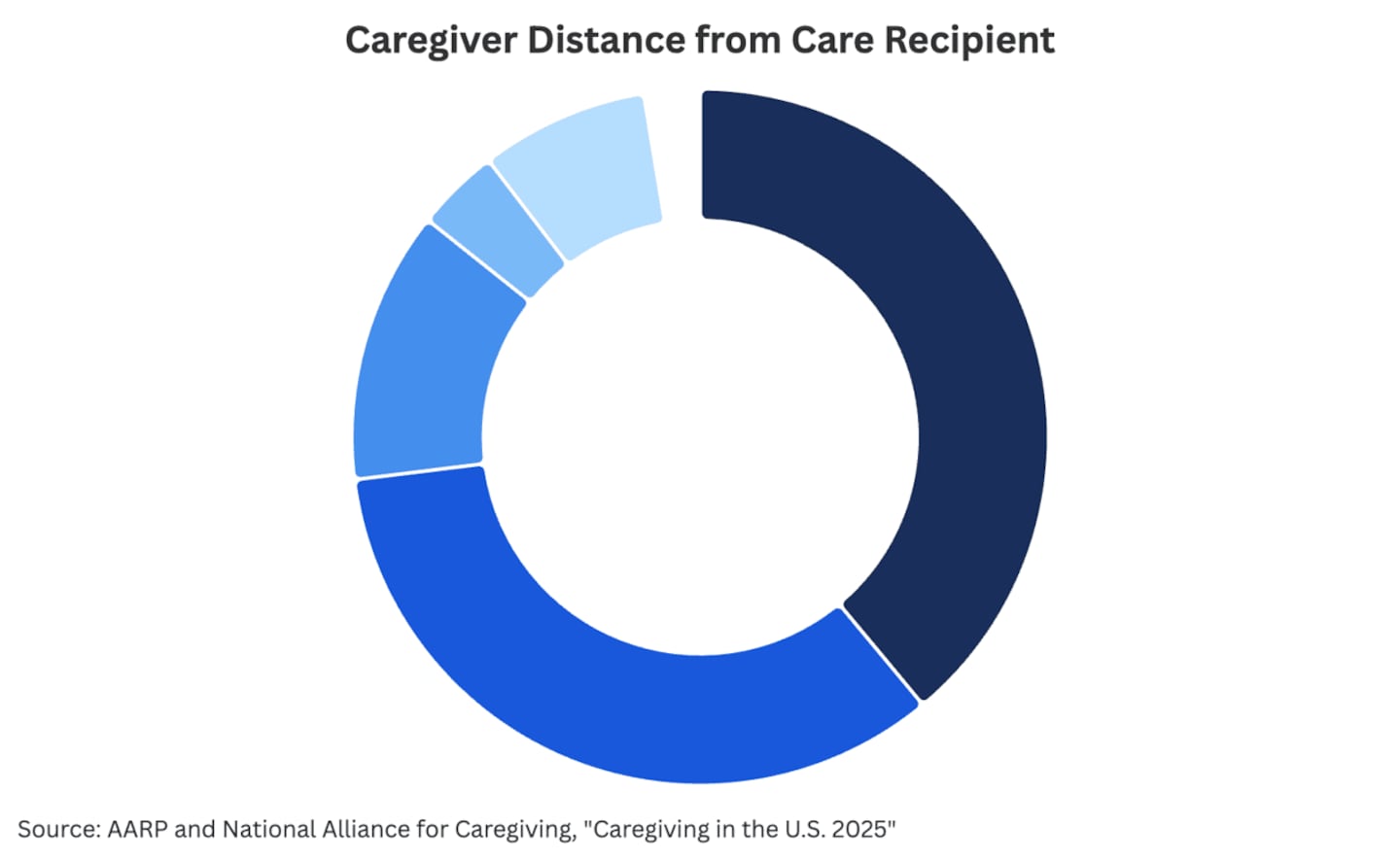
When a parent eventually needs care, sibling geography can become an issue. The AARP and the National Alliance for Caregiving's 2025 survey found that 40% of family caregivers live in the same house as the person they're caring for. Another 35% live within 20 minutes. Only a measly 12% live one to two hours away or farther, meaning the sibling living closest to older parents often takes on the brunt of care responsibilities.
This infographic outlines the divide clearly:
PeopleWin
There is a cost to siblings who carry the burden of care from a distance. When caregivers live over an hour from the person they are caring for, there is a documented increase in both physical and financial strain compared to a caregiver located close by. Travel time, missed work, and the logistics of handling remote care all play a factor.
Coordination is also a challenge. Only 58% of caregivers describe coordinating care with health professionals as easy, which is down 7% from just 2015.
This helps upend the assumption that distance necessarily causes siblings to grow less close. Multiple studies have found that geographic distance doesn’t predict emotional closeness between adult siblings. Emotional closeness and a sense of responsibility towards a person being cared for are two more reliable indicators.
Closing the sibling distance gap
None of this data is a solid predictor for where one person's family will end up compared to another's and how emotionally close they will be if they live farther apart. No matter the distance, families who take the time to prepare will fare better than families that wait until a time of crisis. By dividing responsibilities for an aging parent, having candid conversations about tough subjects like caregiving, maintaining a relationship despite distance, and leaning on digital tools to stay close — including a quick people search to confirm a sibling's current contact details before an important call or visit — adult siblings can preserve their relationship no matter how many miles are between them.
This story was produced by PeopleWin and reviewed and distributed by Stacker.
/cloudfront-us-east-1.images.arcpublishing.com/cmg/LH3JSJEF3VBLRJLJQESEAG34AM.png)


