

Nearly two-thirds of American adults have had an idea for a business they never launched. More than 60% have seen someone else succeed with the idea they had first, and for nearly 1 in 4, that experience hurt.
Those are some of the eye-opening results from Founder Reports' survey of 1,014 U.S. adults about the business ideas they've had throughout their lives. The September 2026 study shed new light on Americans' entrepreneurial aspirations, including feelings of regret and missed opportunities. Based on the data, most business ideas die early, but the real sting comes when people are left to wonder "What if?"
Almost everyone has a business idea, but most don’t act on it
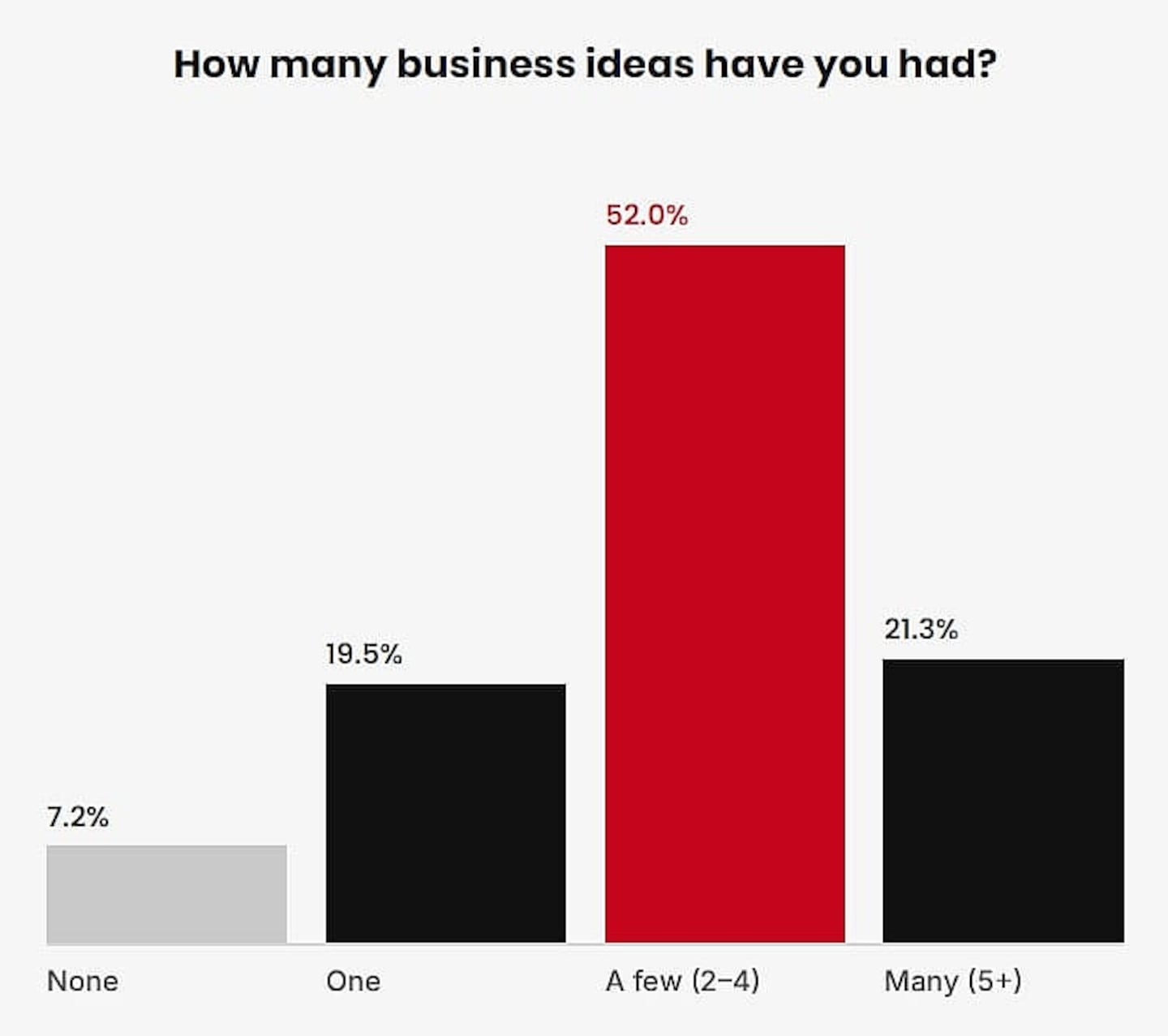
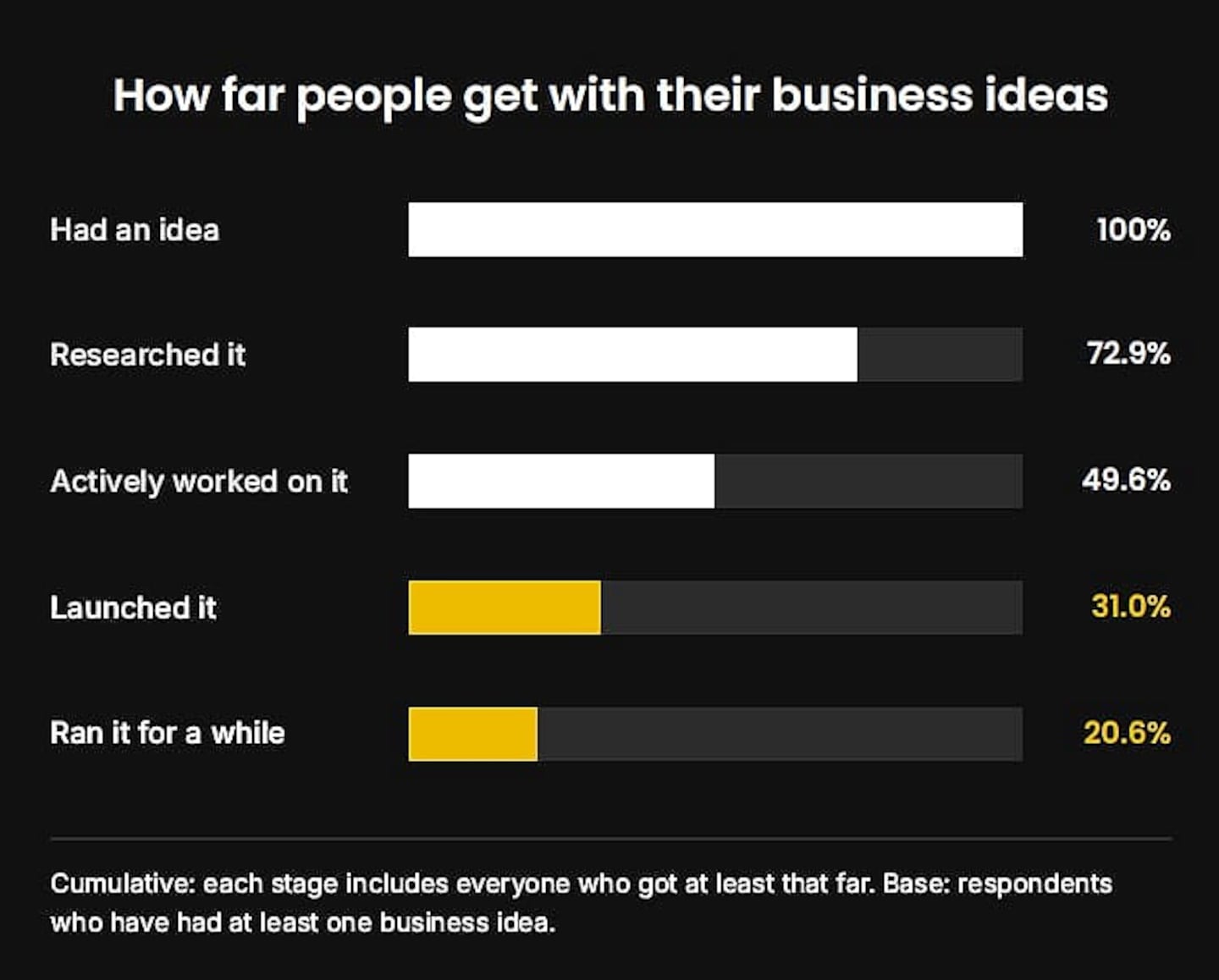
In the Founder Reports business ideas survey, 92.8% of respondents said they've had at least one business idea, but only 28.8% have actually launched a business. Almost two-thirds (64%) are carrying at least one business idea that never came to fruition. Nearly three-quarters (73.3%) of respondents said they've had more than one business idea, including 21.3% with five or more.
Founder Reports
A 2026 LendingTree survey of 2,000 U.S. adults found that 27% have seriously considered starting a business within the past year, confirming that entrepreneurial aspirations are alive and well among today's Americans.
Despite the abundance of ideas and interest in starting a business, most ideas never turn into an enterprise. The LendingTree study found that among those with an idea, just 21% have registered a business name, echoing the Founder Reports conclusion that most ideas die before launching a business.
Why most business ideas die
Starting a business requires many steps after the initial idea, and several reasons prevent ideas from culminating in a business launch. The Founder Reports survey asked those who hadn't launched to identify the primary reason their idea died. Money was the most common answer, as 39.3% identified business funding as their number one obstacle. The second leading answer was that they didn't know what to do next (18%).
A 2024 Justworks survey of 2,000+ U.S. adults reached the same conclusion. Among those interested in starting a business, money (39%) and knowledge of where to start (29%) were the two biggest barriers.
Although money is the barrier most commonly blamed for killing a business idea, internal challenges also prevent many people from pushing forward with their ideas. Starting a business involves publicly putting yourself out there. And with roughly 50% of businesses failing in the first five years, fear of failure is an obstacle that must be overcome.
Will Mitchell, founder of StartupBros, a community for entrepreneurs, has observed that many would-be entrepreneurs stop short before their idea becomes known to others. "Once the idea is public, quitting starts to look like failing," he said. "So it stays an idea, where it's safe and where it cannot embarrass anyone."
Founder Reports
Watching someone else build the business (the part that hurts)
While many would-be entrepreneurs hesitate or decide not to act, others may be actively building businesses rooted in similar ideas.
In the Founder Reports survey, 60.8% of respondents said they’ve seen someone else succeed with a business similar to an idea they didn’t pursue. Nearly 1 in 4 (22.9%) American adults said it bothered them to watch someone else build a business on an idea they had first.
The study also found that watching someone else succeed with a similar idea drastically increased regret. Among respondents who had an idea but never launched, only 8.8% of those who haven’t seen someone else succeed with a similar idea expressed regret. Among those who witnessed someone else succeed with their idea, 24% admitted to having regrets.
It’s easier to be at peace with a missed opportunity when everything is hypothetical, but regret is more likely once someone else proves the idea could have worked.
The science of the “what if”
Psychology plays a part here. Research from Cornell University psychologist Tom Gilovich revealed that in the long term, people are more likely to regret inaction than action. Gilovich concluded that waiting for inspiration is a common excuse.
Research from Daniel Pink, New York Times bestselling author of "The Power of Regret," found that regrets from not doing something outnumber those from taking action by roughly 3-to-1.
According to the Founder Reports survey, regret was more common among respondents who didn’t pursue their idea because they didn’t know what to do or just never took action (23.5%) compared to those who never launched for other reasons (15.7%). This indicates that regret is also more likely when it feels like action could have been taken.
Michael Nadhir, founder of KindMind Behavioral Health, emphasized that "what if" regrets aren't really about the idea or missed opportunity. He said the regret is "about what the inaction says to them about themselves."
What to do with the idea you’re holding onto
For some people, watching someone else build the business they had envisioned is what finally pushes them to step out and take their own leap of faith.
In 2017, Andrew Gazdecki had an idea to create a marketplace for small acquisitions of online businesses. Other marketplaces and brokers existed, but all focused on larger transactions, and most ignored small businesses and startups. Despite his interest, Gazdecki hesitated. “I convinced myself the market was too small,” he said.
But after seeing others bring the same concept to fruition, Gazdecki took action and launched MicroAquire, which later became Acquire. "Watching others do it, it sort of hurts, but it taught me not to hesitate too much on things that feel like good opportunities," he commented. Since launching in 2020, Acquire has facilitated the sale of more than 5,000 businesses totaling more than $1 billion, showing that success is still possible even after initial hesitation.
For those still holding onto an idea and hesitant to move forward, the data suggests lasting regret doesn’t usually come from trying and failing, but rather from never trying and wondering “what if?”
Survey methodology
Founder Reports surveyed 1,014 U.S. adults in September 2026. Respondents answered five questions about how many business ideas they've had, how far the furthest one traveled, whether they've seen someone else succeed with a similar idea, why they stopped, and how they feel about that idea today. The data is based on self-reported responses.
This story was produced by Founder Reports and reviewed and distributed by Stacker.
/cloudfront-us-east-1.images.arcpublishing.com/cmg/LH3JSJEF3VBLRJLJQESEAG34AM.png)


