

In April 2024, Data by Toast surveyed 850 U.S. diners about how they were feeling about rising menu prices, then conducted a similar survey in July 2026. Prices have kept climbing in the two years between waves, and so has guest skepticism—but not in the way that might show up in a restaurant's traffic numbers.
Do guests think restaurant price increases are justified?
Fewer than they did two years ago. In 2024, 41% of respondents said price increases were "completely justified," and only 10% said they weren't justified at all. In 2026, just 18% say increases are justified, while 25% say they're not. That's close to a reversal in two years.
It is important to note that the 2026 wave phrased the response options slightly differently: "yes / somewhat / no" versus "completely justified / somewhat / not justified at all" in 2024. So this should be read as a directional shift rather than a word-for-word repeat. The direction, though, is unambiguous.
How much do guests think menu prices have gone up?
Guests think prices have gone up more than they estimated in 2024. That year, 41% of respondents guessed prices were up 10–20%. In 2026, 54% put the increase in that same range. Whatever the actual number has been, guests' sense of it has intensified.
Are guests actually dining out less because of price increases?
Guests say they are dining out only slightly less than they were two years ago, and cost of living, not menu prices specifically, is the bigger driver. In 2024, 55% of respondents said they were dining out less frequently than the year before. In 2026, it's 53%, essentially flat. Skepticism about pricing has grown substantially. Actual pullback in dining-out frequency has not.
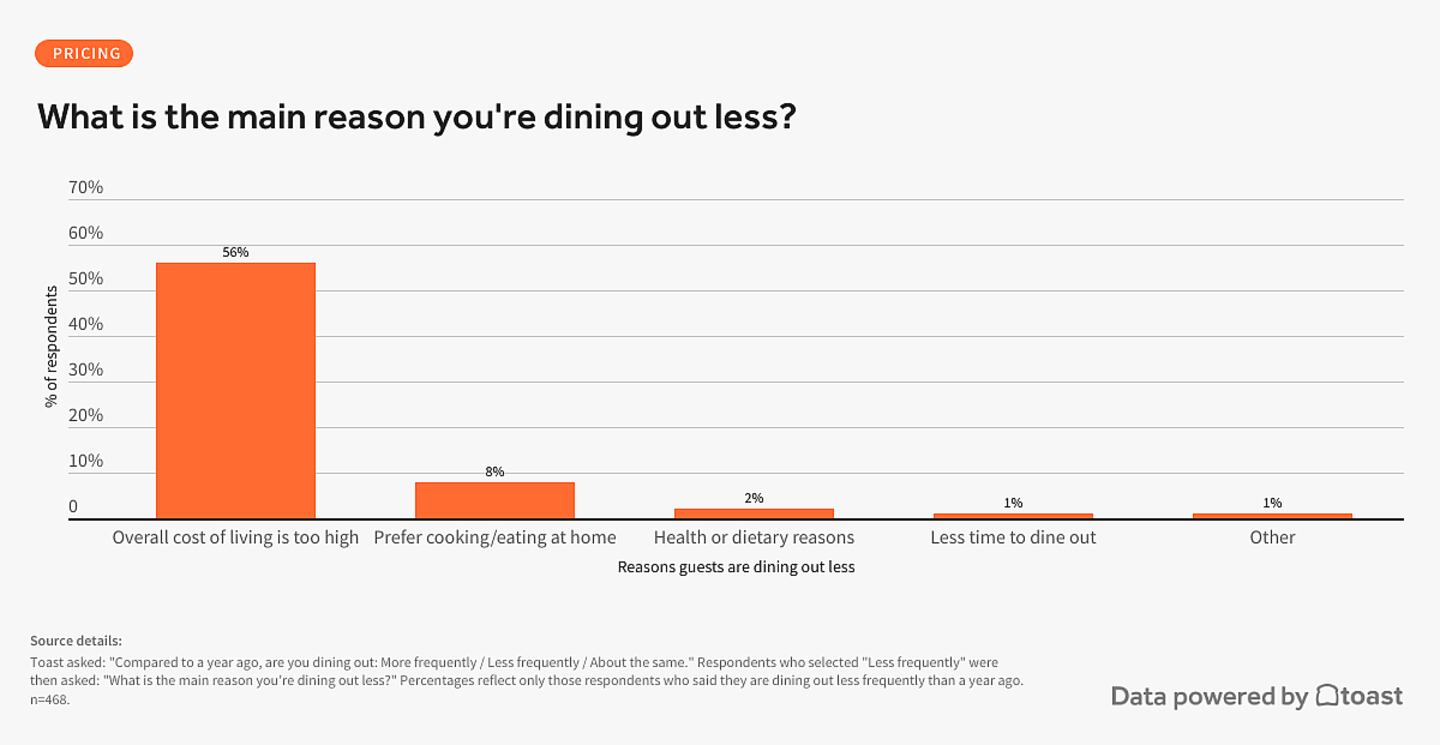
Among guests who are dining out less, 56% point to the overall cost of living as the main reason, versus 33% who name menu prices specifically. Guests aren't holding restaurants uniquely responsible for tighter budgets.
Toast
How are restaurant guests adapting instead of dining out less?
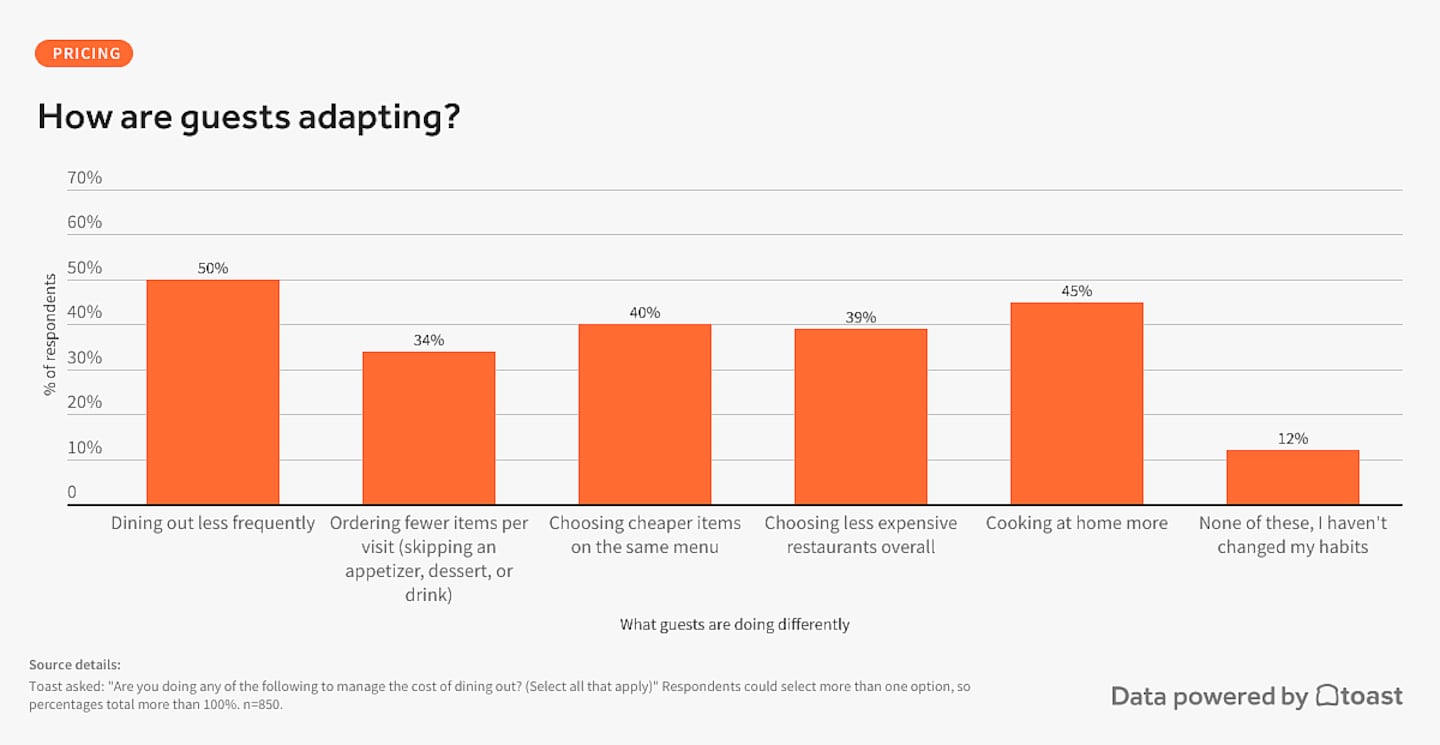
Instead of abandoning dining out entirely, most customers are actively adapting their habits. In fact, a mere 12% report making no changes at all. The vast majority are making strategic adjustments: 45% are preparing more meals at home, 40% choose lower-cost options from the same menu, and 39% opt for less expensive dining establishments. Overall, this reflects a customer base actively managing its budget within the restaurant sector rather than departing from it.
Toast
Do guests want restaurants to tell them before raising prices?
Over two years, guest demand for advance notice on menu price increases has remained remarkably steady. When asked across both survey waves if restaurants should communicate price hikes ahead of time, 70% of respondents agreed in 2024, compared to 69% in 2026.
This persistent expectation is perhaps the survey's most actionable takeaway. Rather than a fleeting sentiment, it's a stable, ongoing desire that's gone largely unaddressed for two years running — giving operators an accessible way to ease guest concerns without altering a single menu price.
Do guests understand why restaurant prices are rising?
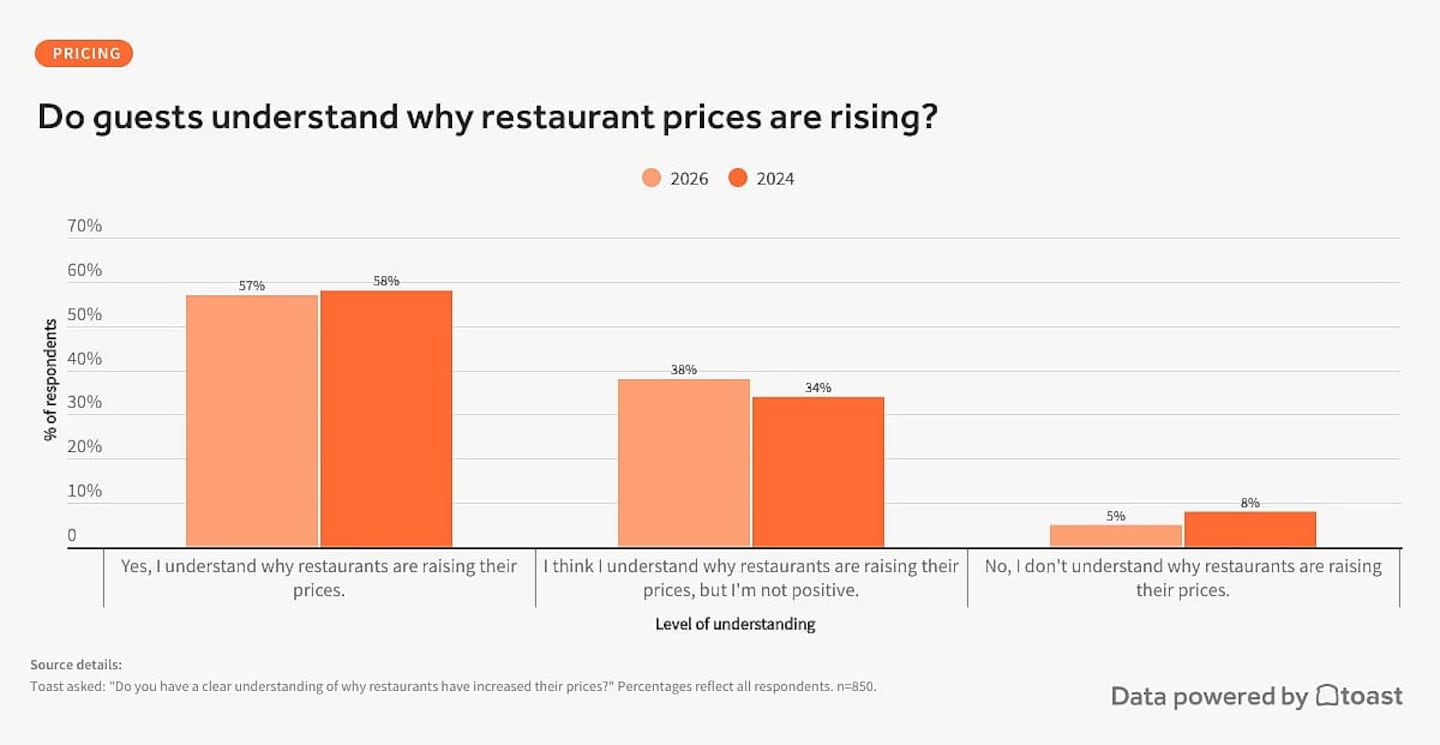
Yes, and that hasn't eroded either. In 2026, 57% of guests say they clearly understand why restaurants are raising prices — nearly identical to 2024's 58%. Asked which specific factors justify the increases, guests named the same drivers operators would: rising ingredient and food costs (77%), inflation generally (70%), and labor costs (57%).
So the drop in "justified" sentiment isn't guests losing the plot about the reason; they know what's driving costs up. What seems to be wearing thin is patience: Understanding a price increase and feeling okay about it are two different things, and two years of cumulative increases have widened the gap between them.
Toast
What should restaurant operators take away from this?
None of this points to a guest base that's checked out. It points to one that's more cost-aware, more willing to trade down within a restaurant relationship rather than end it, and still asking for the same small thing it asked for two years ago: a heads-up before the price on the menu changes.
Frequently Asked Questions
Is it true that fewer guests think restaurant price increases are justified than in 2024?
Yes. In 2024, 41% of guests called price increases "completely justified." In 2026, only 18% say increases are justified, while 25% say they're not.
Has the amount guests dine out actually changed since 2024?
Only slightly. 55% of guests said they were dining out less often in 2024, compared with 53% in 2026 — a roughly flat trend despite rising skepticism about pricing.
Why are guests dining out less, if not primarily because of menu prices?
56% of guests who are dining out less cite the overall cost of living as the main reason, compared with 33% who cite menu prices specifically.
Do guests want restaurants to announce price increases in advance?
Yes. 69% of guests in 2026 said they'd prefer restaurants communicate a price increase ahead of time, nearly identical to the 70% who said the same in 2024.
Do guests understand why restaurants are raising prices?
Yes. 57% of guests in 2026 say they clearly understand why restaurants are raising prices, matching the 57% who said the same in 2024. The top cited justifications are rising ingredient/food costs (77%), inflation (70%), and labor costs (57%).
Methodology: Toast conducted a blind survey of 850 U.S. adults ages 18+ on this topic on July 31st, 2026 and April 23, 2024. Respondents were not made aware that Toast was fielding the study. Using a standard margin of error calculation, at a confidence interval of 95%, the margin of error on average is +/- 3-5%.
This story was produced by Toast and reviewed and distributed by Stacker.
/cloudfront-us-east-1.images.arcpublishing.com/cmg/LH3JSJEF3VBLRJLJQESEAG34AM.png)


