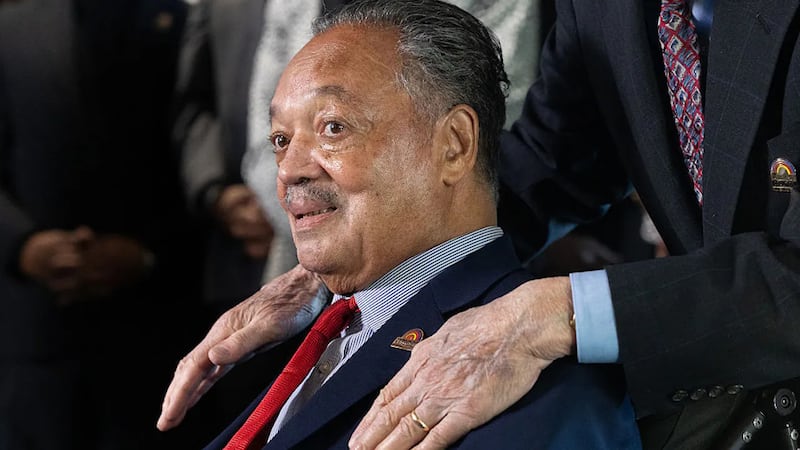
SALISBURY, N.C. — The Rev. Jesse Jackson, a longtime civil rights leader, two-time presidential candidate and protégé of the Rev. Martin Luther King Jr., has died at 84. For more than 50 years, Jackson pushed for racial equality and economic justice, and we spoke with one of the Greenville Eight about his lasting impact.
‘Keep hope alive’
Jackson’s lifelong fight for equality was known the world over, but his story started in the Carolinas.
“I was born in Greenville, South Carolina, in rampant radical racial segregation, had to be taught to go to the back of the bus or be arrested,” Jackson had said.
Jackson went to college at North Carolina A&T in Greensboro.
At that time, four A&T students had already started their sit-ins at a segregated lunch counter.
The Greensboro Four’s movement would spread across the south as Jackson grew into a leader on campus.
He was student government president and quarterback of the football team.
“If someone like him can come from A&T and do great works all over the world, it’s encouraging that there is still hope for people like me,” student Maison Jackson said Tuesday.
His work would eventually connect him to The Rev. Martin Luther King Jr.
Jackson was in the Memphis hotel room the night in 1968 when King was assassinated.
“I learned so much from him, such a great source of inspiration,” Jackson said of King.
Three years later, Jackson found what became the Rainbow PUSH Coalition and led the civil rights organization for more than 50 years.
Jackson ran for president in 1984 and 1988.
His campaign frequently brought him to the Carolinas, and he ended up finishing second in the Democratic Primary.
At that time, it was the farthest any Black candidate had gone in a presidential contest.
Jackson would also deal with scandal and controversy.
During his first presidential run, he apologized after using a slur to describe Jewish people.
In 2001, he acknowledged having a child outside of his marriage with a former staffer from his nonprofit.
Jackson stayed involved in politics and continued his visits to the Carolinas, included in 2015, after South Carolina Gov. Nikki Haley ordered the state to remove the Confederate flag and in 2016 to support Sec. Hillary Clinton’s run for president.
“The Black vote must be part of a broader coalition,” Jackson said. “When the Panthers play football, we choose uniform color, not skin color, direction not complexion. We all matter. We’re all on the same team called America.”
Jackson’s final fight was against a rare neurological disease that’s often mistaken for Parkinson’s disease.
He was diagnosed in 2017 but made public appearances through 2024.
“We must never surrender,” he said. “America will keep getting better and better. Keep hope alive.”
‘We marched’
Jackson started his push for civil rights in his hometown of Greenville, South Carolina.
He was part of The Greenville Eight, a group of young people who helped desegregate the Greenville Public Library system.
South Carolina reporter Tina Terry sat down with one of them, Dorris “Dee Dee” Wright, who now lives in Salisbury.
She grew up in Greenville with a young Jackson.
They went to school together and took part in a protest and had no idea they would shape history.
“And growing up poor but loved,” Wright said. “We never knew that we were poor because we made a way, in the religious term, we made a way out of no way.”
Wright has lived her life making a way where there seemed to be none.
“We had parents who loved us,” Wright said. “And I’m sure that we used to scare them a lot because I was arrested maybe five or six times.”
She and seven others tried to use the whites-only library, and they were arrested.
Wright said the protest wasn’t planned but developed naturally when Jackson needed to do some research for a homework assignment.
“We marched to the library and of course, they had a knack for shutting the lights off,” she said. “That meant the library was closed, so we left.”
“He said I that’s not why I sent you there,” Wright said. “We want to make sure that you can use that library that your parents are paying taxes on, so we went back and we went back there and they arrested us.”
There is a picture of the young people called the Greenville Eight at the Greenville County jail.
Their sacrifice led to desegregation of the Greenville library system.
“And what people need to realize is that the movement was carried on by the youth,” she said. “Because if our parents were to participate, they would lose their jobs.”
She’s proud of her friend who went on to fight for civil rights on a larger stage marching with Dr. Martin Luther King Jr., impacting party politics, and becoming the first Black candidate to run a major nationally competitive campaign for president.
“Jesse was a leader and I believe that he was God chosen. I really do,” she said.
South Carolina Gov. Henry McMaster called Jackson a native son of South Carolina and an icon of the Civil Rights Movement.
He said he’ll direct flags over the capitol to be lowered to honor his legacy and memory.
The Greenville Public Library is on the National Register of Historic Places.
VIDEO: World reacts to death of civil rights activist
©2026 Cox Media Group
/cloudfront-us-east-1.images.arcpublishing.com/cmg/LH3JSJEF3VBLRJLJQESEAG34AM.png)


